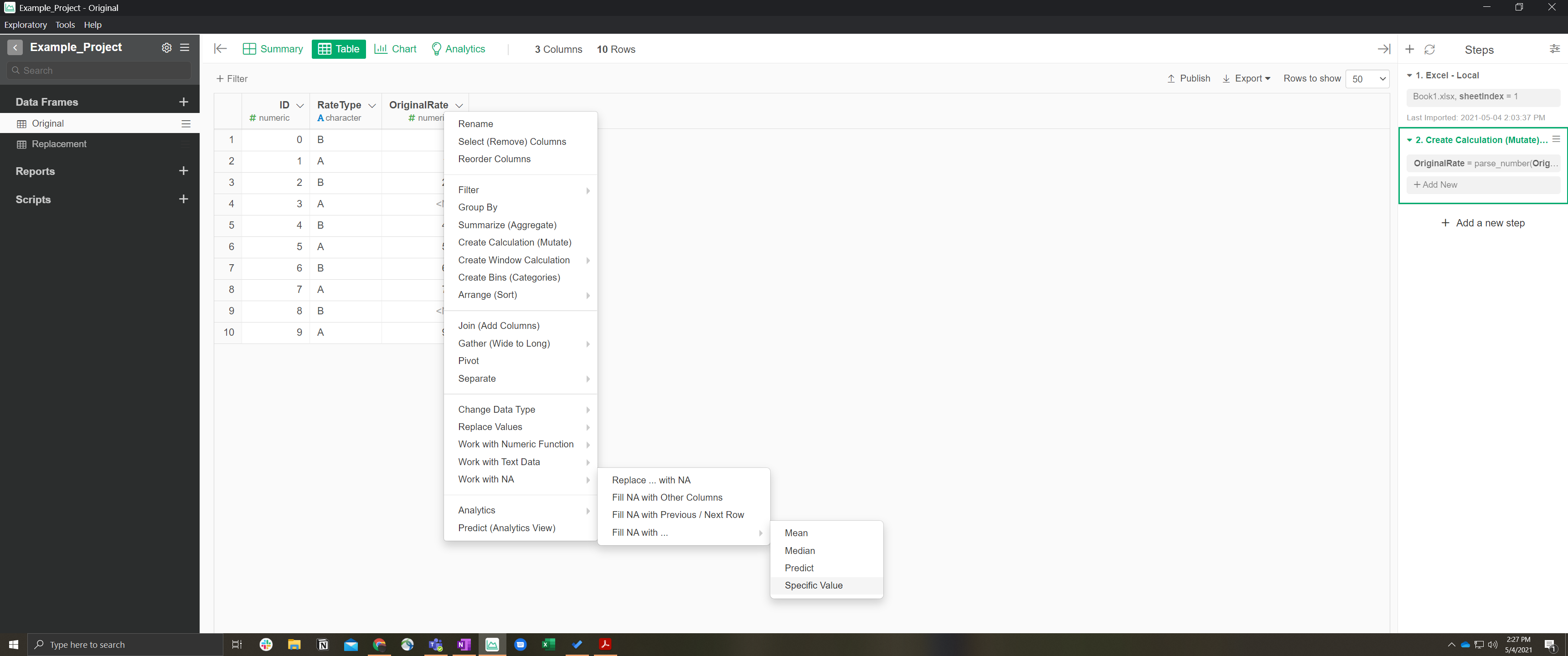
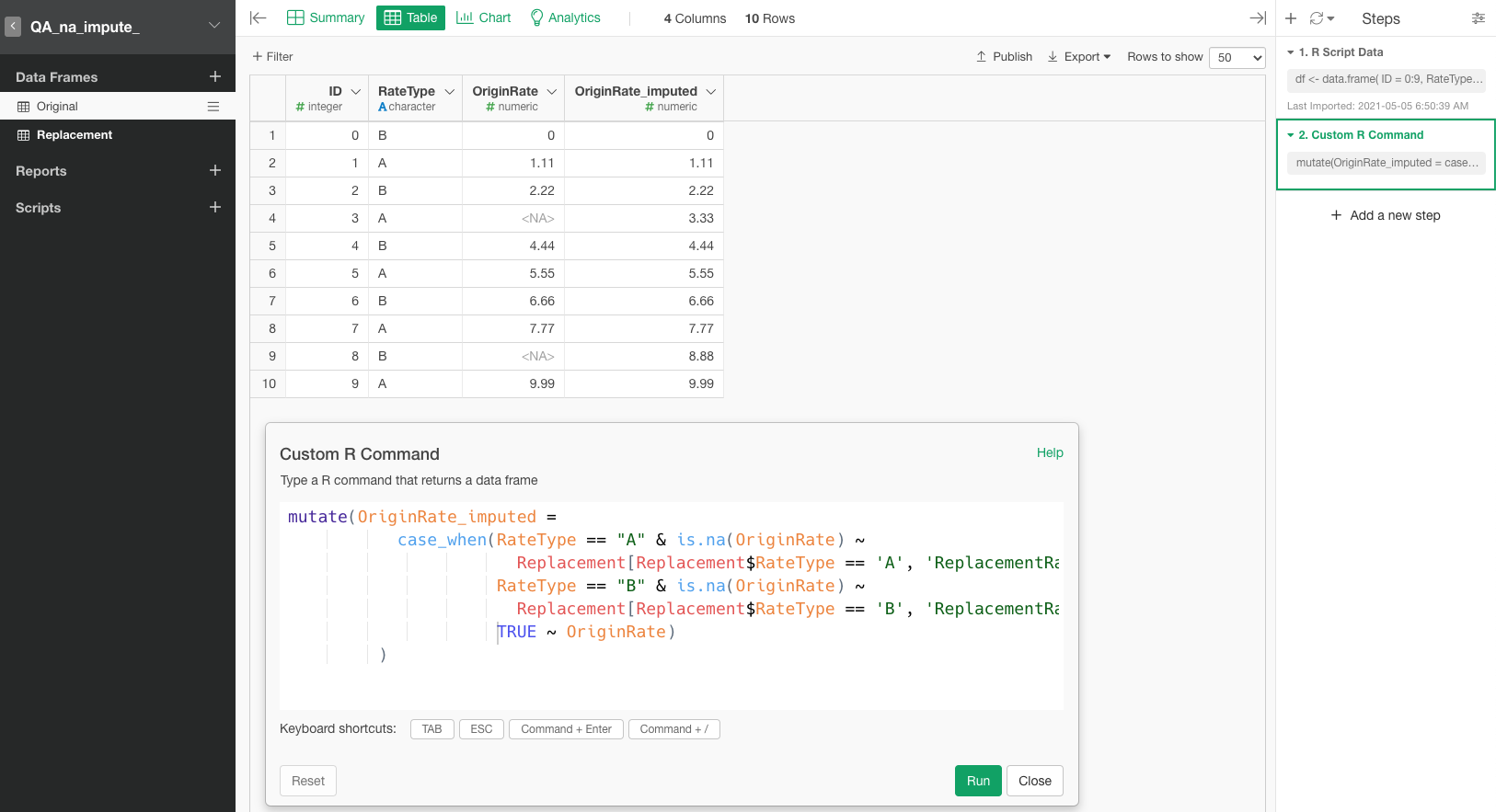
impute_na(OriginalRate, type = "value", val = Replacement$ReplacementRate[Replacement$RateType==RateType])
And received this error:
'2. Create Calculation (Mutate)' step has an error. Error : Problem with `mutate()` input `OriginalRate`. x Can't recycle `..1` (size 10) to match `..2` (size 0). i Input `OriginalRate` is `impute_na(...)`.
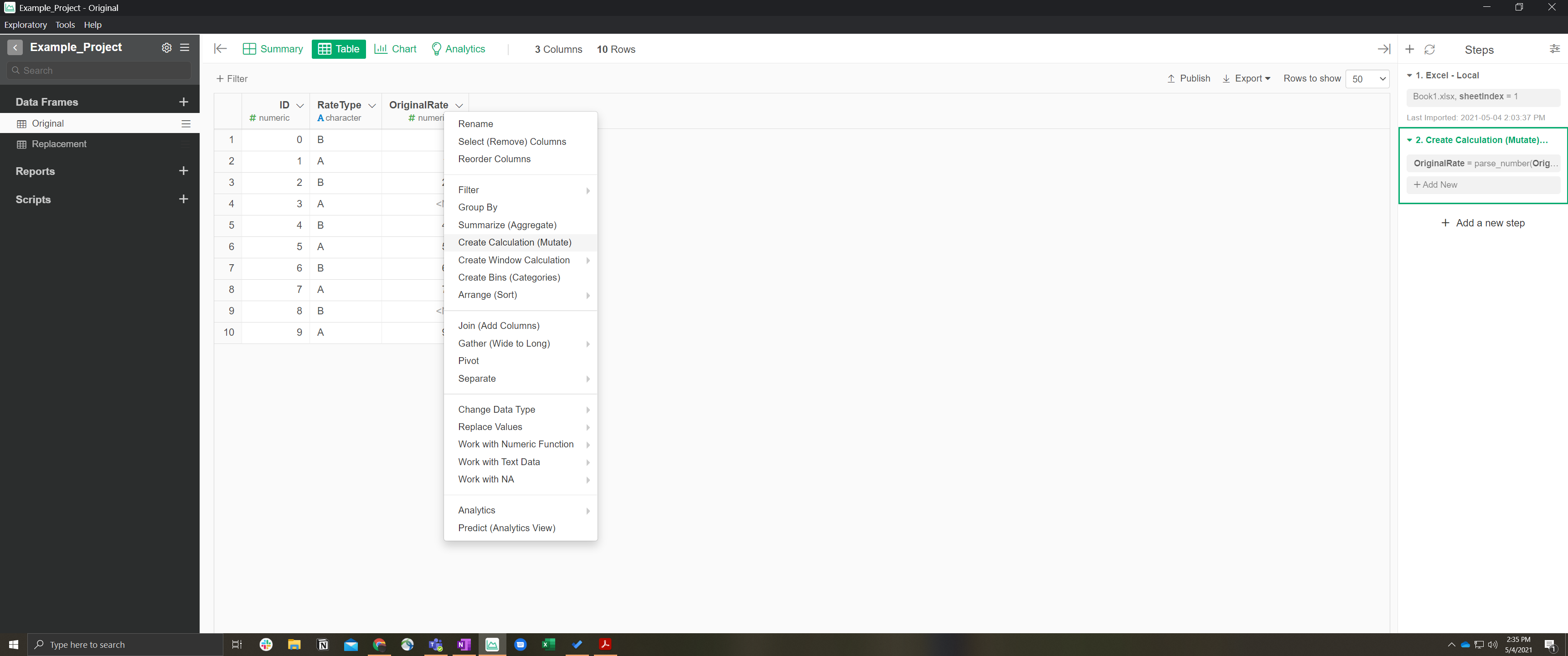
For the second attempt, I tried the mutate function:
'2. Create Calculation (Mutate)' step has an error. Error : Problem with `mutate()` input `OriginalRate`. x `true` must be length 10 (length of `condition`) or one, not 0. i Input `OriginalRate` is `if_else(...)`.
I suspect this has something to do with the scalar vs vector issue that @sugiaki nicely explained previously here:
but I still have no idea how to move past this!
Also, here another post that others might find helpful, where @user1 describes how to access the value in another dataframe:
What is the best way to do this? (I prefer to not use a join.)
I think it would be easier to use the Join function, since it would require rewrite code when there are more categories to replace NA or some change…how about the following method?
I think any of the following writing methods will work. The purpose of the script is the same.
# Get the ReplacementRate where RateType is A.
1. Replacement[Replacement$RateType == 'A', 'ReplacementRate']
2. Replacement %>% filter(RateType == 'A') %>% select(ReplacementRate) %>% pull()
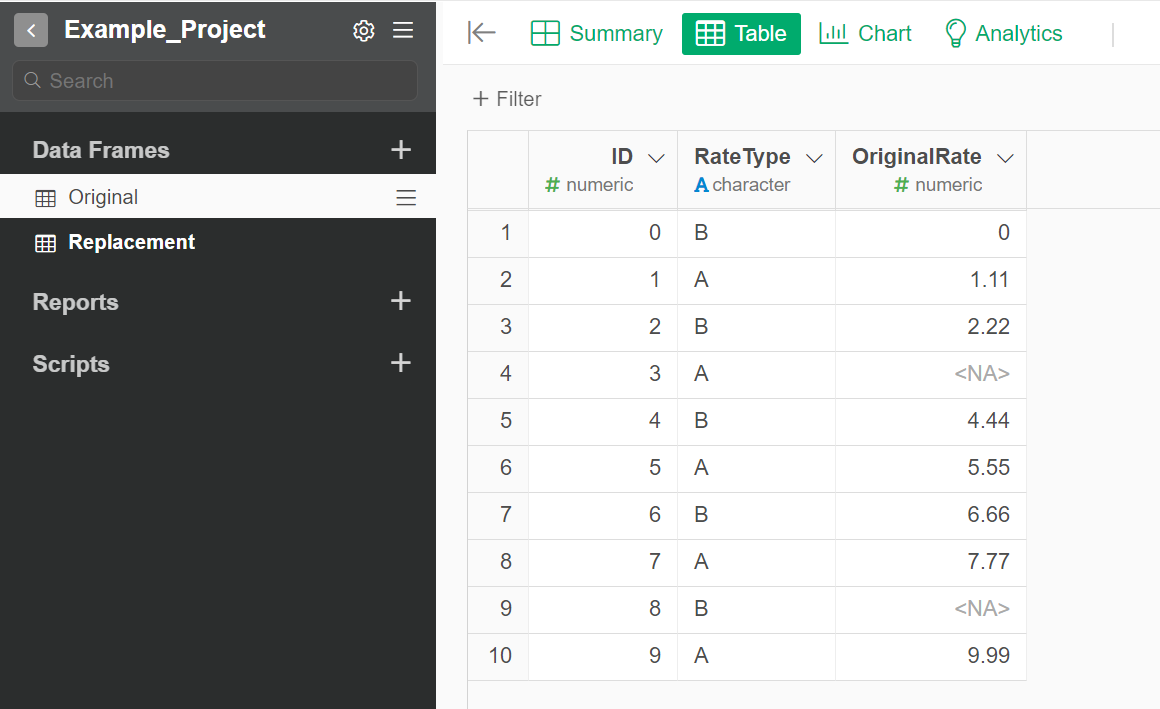
The sample data was generated from the following code.
# Make `Original` dataframe
Original <-
  data.frame(
    ID = 0:9,
    RateType = rep(c('B', 'A'), times = 5),
    OriginRate = seq(0, 9.99, length.out = 10)
  )
Original[4,3] <- NA
Original[9,3] <- NA

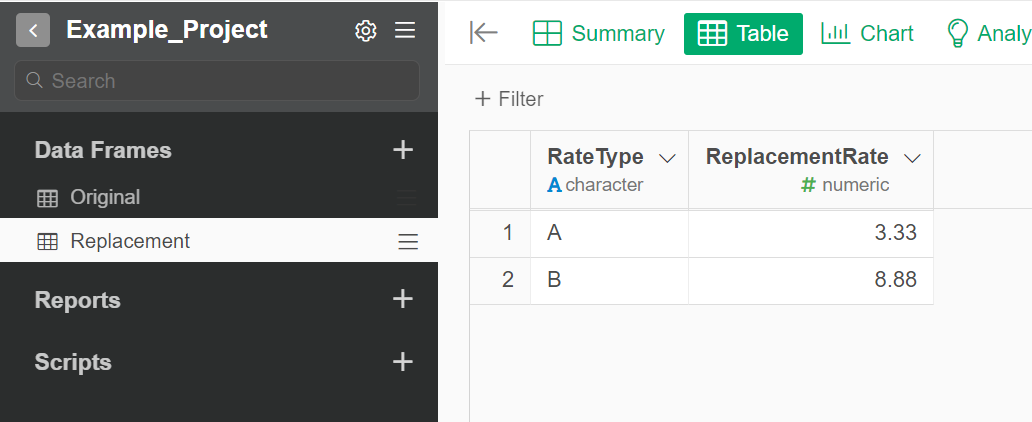
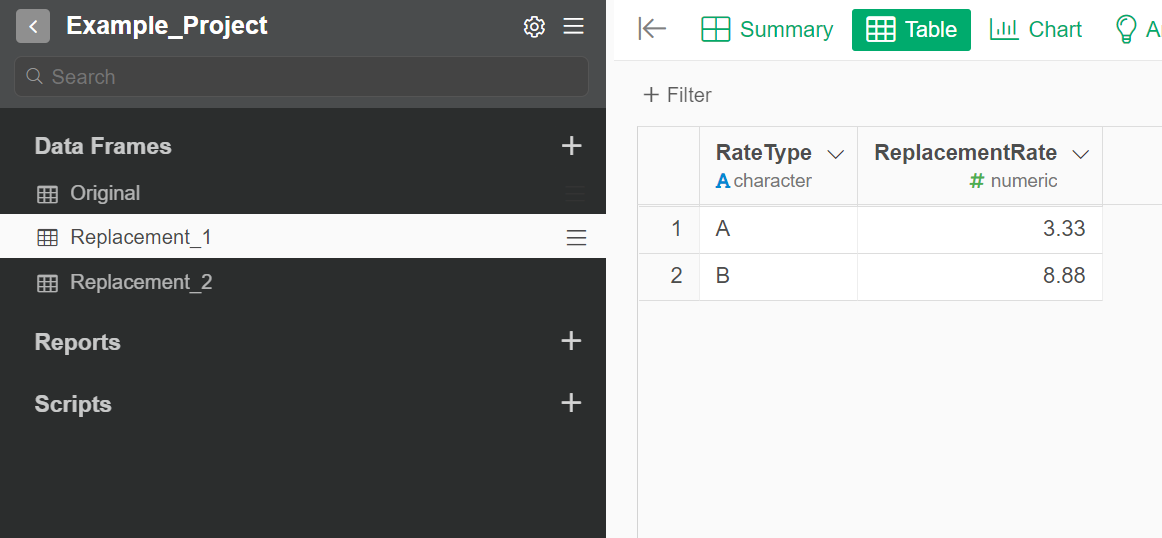
# Make `Replacement` dataframe
Replacement <-
  data.frame(RateType = c('A','B'),
             ReplacementRate = c(3.33, 8.88)
             )
To me, using join() is a straightforward way to do it because you anyway need to refer to a different data frame. Also, on Exploratory Desktop, you can use UI for the join operation so you don’t need to maintain the code. Is there any particular reason you don’t want to use it?
@sugiaki Thank you so much for your detailed answer. As you may have guessed, the inflexibility of coding it this way is a liability, so I think what you have proposed is a last resort.
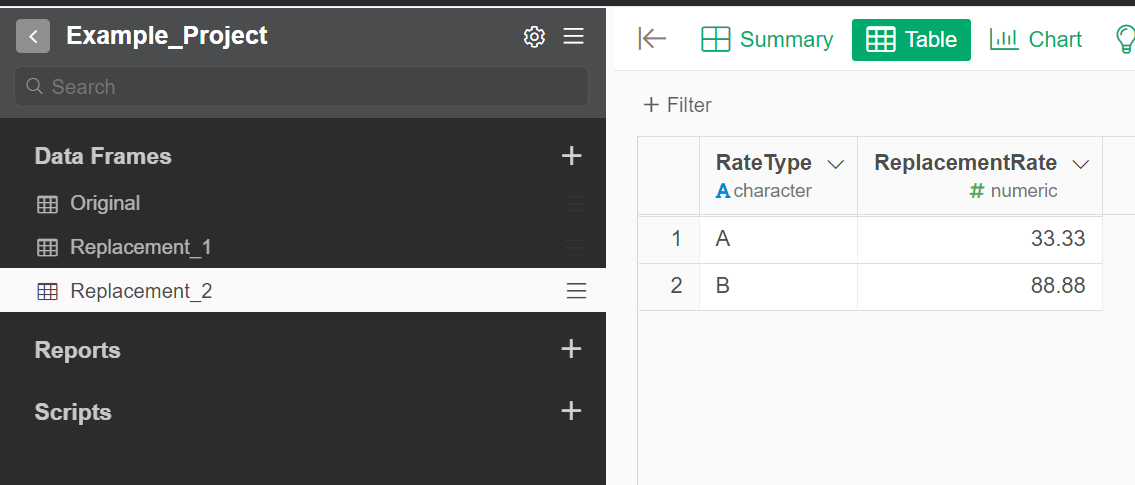
@user1 regarding the join question, for my use case, I have two different categories of data that would need to be filtered before a join.
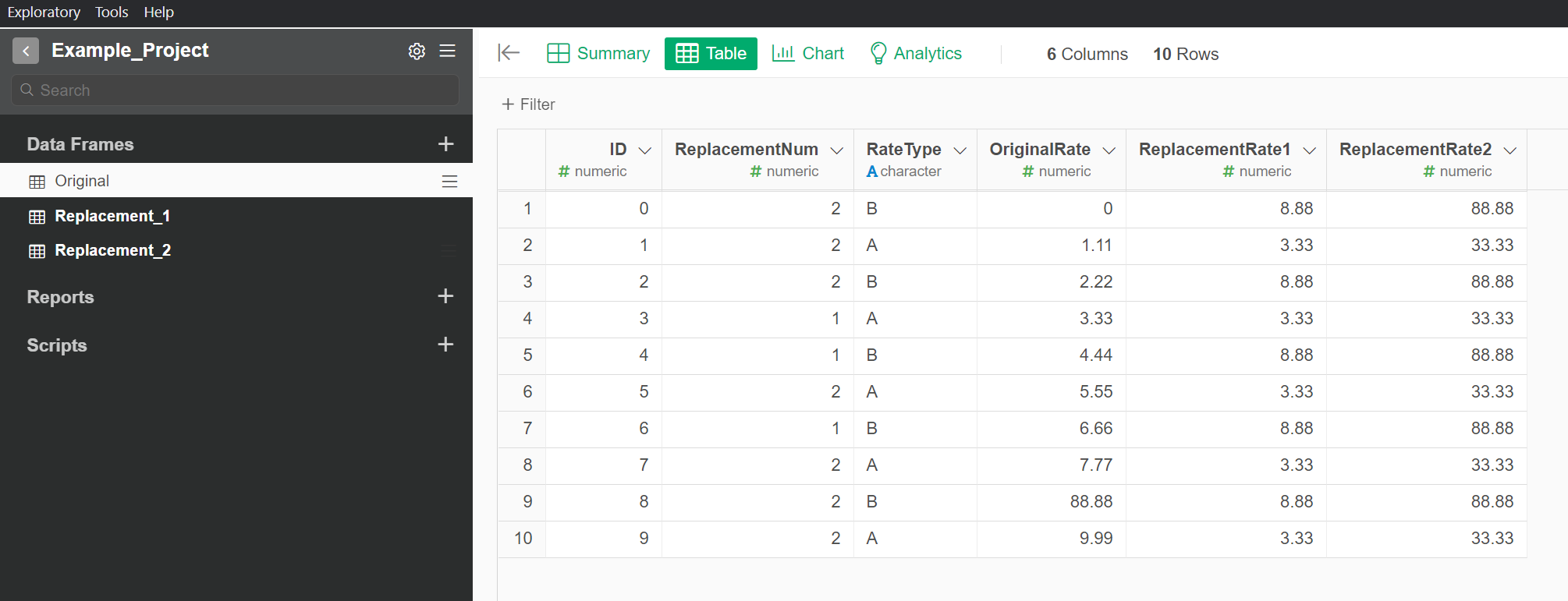
Let me see if I can explain my situation just a bit more clearly.
Similiar to what is shown below, there is an additional column:
Here is the code that worked: if_else(ReplacementNum == 1, impute_na(OriginalRate, type = "value", val = ReplacementRate1),impute_na(OriginalRate, type = "value", val = ReplacementRate2))